
Shri Akroorji Maharaj
// Salutations to Shri Krishna //
Shri Akroor Ji, Eminent Scion of the Vrishni Lineage
The temple’s original Hindi account describes Shwaphalk’s far-reaching business connections and financial skill, Akroor Ji’s scholarly and saintly nature shaped by Kashi, his role in bringing Krishna to Mathura at Kansa’s request, Krishna’s respect for him as teacher and uncle, his mission to Hastinapur before the Mahabharata war, his reputation for generosity, and the trust placed in him to manage Dwarika’s economy and the Syamantaka jewel.
tvN no guruuH pitRvyssc sslaadhyo bndhussc nitydaa /
vNy tu rkssyaaH poshyaassc anukmpyaaH prjaahi vH / / 29 / /
(shriimdbhaagvt sk10-a048)
bho bho daanpte mdhyN kriytaaN maitraamaadRtH /
naanystkto hittmo vidyte bhojvRshnnishu / / 28 / /
(shriimdbhaagvt-sk10-a036)
nnu daanpte nyststvyyaaste sstdhnvnaa /
symntkomnniH shriimaan viditH puurvmevnH / / 36 / /
(shriimdbhaagvt-sk010-a057)
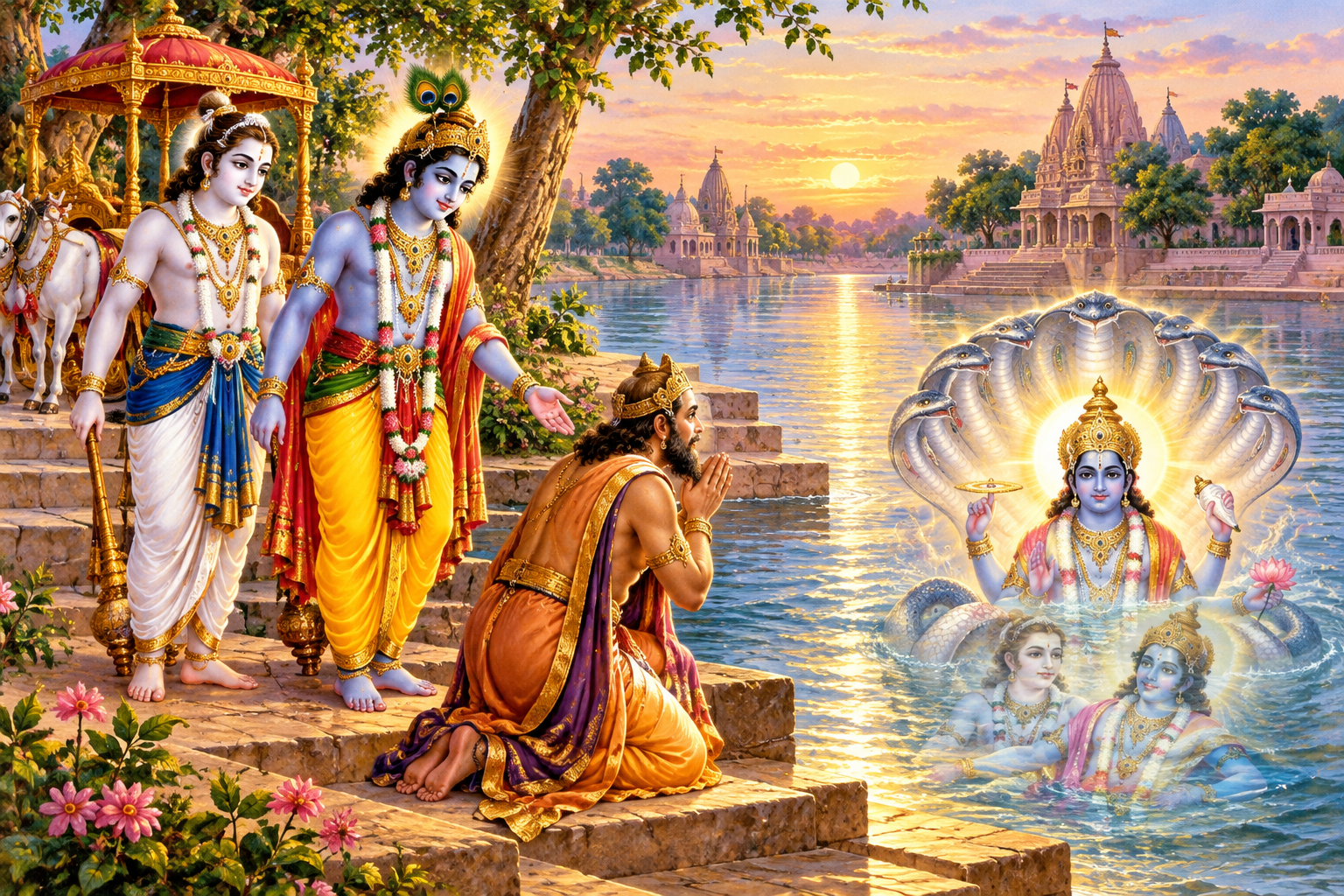
While Akroor Ji was bringing Krishna and Balarama to Mathura, their tender, gentle, virtuous and beautiful appearance filled him with wonder; the account says Krishna first revealed his Vishnu form to Akroor Ji in this episode (Bhagavata, Canto 10, Chapter 39, verses 40–55).
Akroor Village, Akroor Ghat and Shri Akroor Ji Temple
The source describes Akroor Ghat (Anant Tirth) on the Yamuna, where Krishna showed Akroor Ji both the two-armed Krishna-Balarama form and the four-armed eternal form seated on Shesha, served by all incarnations. The Garga Samhita’s Mathura section and the Varaha Purana are cited; the latter compares bathing here during a solar eclipse with the merit of Rajasuya and Ashvamedha sacrifices, and with bathing at Kurukshetra after an eclipse.
tiirthraaj hickruurNguuhyaanaaN guuhymuttmm /
ttphlN smvaapnoti srvtiirthaavgaahnaat / /
akruure c punH snaatvaa raahuugRste divaakre /
raajsuuyaassvmedhaabhyN phlmaapnoti maanvH / /
(vaaraah puraann)
After the Mahabharata war, at Arjuna’s request, Krishna is said to have revealed his original form again at this pool. Bhaktiratnakar and the Shaurya Purana (Vachan Pancham) are cited for the belief that bathing at Akroor Ghat on a full moon, especially Kartik Purnima—the day Chaitanya Mahaprabhu visited Akroor village—frees a person from worldly cycles.
anntrmti shreshtthN srvpaap vinaassnN /
akruurtiirthmtyrthmsti priytrN hre: / /
puurnnimaayaantu yH snaayaat ttrtiirthvre nrH /
s muktev sNsaaraat kaartikyaantu visseshtH / /
(bhktirtnaakr saurypuraann-vcn pNcm)
The original account states that Akroor village still stands near the ghat and dates back to the Dvapara age. It says Akroor Ji had twelve brothers and that their twelve branches later helped resettle Mathura under Vajra, Krishna’s great-grandson and Aniruddha’s son. It records a Krishna-Balarama temple here in Vikram Samvat 450 (393 CE), now in ruins, remains of an ancient pool, and the local tradition that the images of Taleshwar Mahadev and Krishna-Balarama emerged from that pool.
The Chaitanya Charitamrita reference says Chaitanya Mahaprabhu visited in 1515 CE and, after bathing at Akroor Ghat, fainted in devotional ecstasy, experiencing the same emotion attributed to Akroor Ji. The account mentions the 1534 CE establishment of Madan Mohan and Govind Dev temples in Vrindavan, disciples receiving alms from Akroor village, the settlement being the only one on the Mathura–Vrindavan route, and installation of images in a new temple by Barahsaini or Varshney Vaishyas in 1693. It also notes the ancient Panchmukhi Hanuman and Ghateshwar Mahadev shrines.
Dedicated to Krishna, Balarama and Akroor Ji, the temple is on the Mathura–Vrindavan route, on the road opposite Sadhvi Ritambhara Ji’s Vatsalya Gram. The source describes it as a unique sacred site for the Varshney community and says the Mathura–Vrindavan parikrama is incomplete without visiting Akroordham. Darshan of Panchmukhi Hanuman and Kamadhenu in the complex is considered especially auspicious.
striibaalvRddhaanaadaay htsseshaan dhn'jyH /
indrprsthN smaavessy vjNr ttraabhyshecyt / / 25 / /
(shriimdbhaagvt-sk0 11-a031)
maathure tvbhishikto'pi sthito'hN nirjn vne /
kk gtaa vai prjaatrtyaa ytr raajyN prrocte / / 15 / /
(shriimdbhaagvt mhaatmy a01)
— Shri Vrishni (Varshney) Kula Katha, Shri Akroor Smriti Granth